In The News

An Appeal to Support the St. Joseph House Shelter of Hyannis from Father Tom of Holy Trinity Church”
“One of the clearest teachings of Jesus is that we are called to recognize Him in those who are most vulnerable. In the Gospel of Matthew, Jesus tells us, “Whatever you did for one of these least brothers or sisters of mine, you did for me.” Those words are not simply an invitation to charity; they are a call to discipleship. As Christians, we cannot look away from those who are hungry, lonely, struggling, or without a place to call home. They are our neighbors, and they are our brothers and sisters in Christ.
Here on Cape Cod, many people experience homelessness for reasons that are far more complex than we often realize. Some struggle with mental illness, addiction, or the loss of employment. Others have endured family crises or simply cannot keep up with the rising cost of housing. While every person’s story is different, every person possesses the same God-given dignity. They deserve to be treated not with fear or indifference, but with compassion, respect, and hope.
Our strongest effort to do our part to reach out to those in need here on the Cape is the St. Joseph House Shelter in Hyannis, a refuge for those without a roof over their head that serves all of Cape Cod. The house is currently in the process of moving to a new location that will better serve the needs of those in need, as well as the community at large.
Unfortunately, this move is facing some serious opposition; and as is the regular case in our modern world, most of the opposition swirls around rumors and conspiracies trying to gin up people’s deepest fears of those who are less fortunate than us. The internet is full of false information, but as they say, a rumor travels the world while the truth is still putting its boots on.
I strongly support the proposed relocation of St. Joseph House to its new site. The shelter has a long history of providing safe, compassionate care for those who have nowhere else to turn, and already has a well-established track record of being a good neighbor in the community. Relocating the shelter will allow this important ministry to continue serving our neighbors in need in a facility better suited to its mission.”
Father Tom, pastor and Dean of the Cape and Islands, and a priest who believes that caring for those in need is at the very heart of the Gospel. I … offer a voice of faith, reminding our community that our response to homelessness says much about who we are and what we value.
Affordable housing lotteries for homes in Brewster and Sandwich announced in Cape Cod Times 4/8/2026. See article here: https://www.capecodtimes.com/story/news/2026/04/08/affordable-homes-brewster-sandwich-ma-lottery-for-sale/89489615007/?utm_source=capecodtimes-newsalert-strada&utm_medium=email&utm_campaign=newsalert&utm_term=hero&utm_content=ncct-hyannis-nletter01 or go to Housing Assistance Corporation website, https://haconcapecod.org/
The scholarship application deadline for the Father Ken Campbell Social Justice scholarship has been extended until May 1, 2026. All interested students are encouraged to apply.

November, 2025
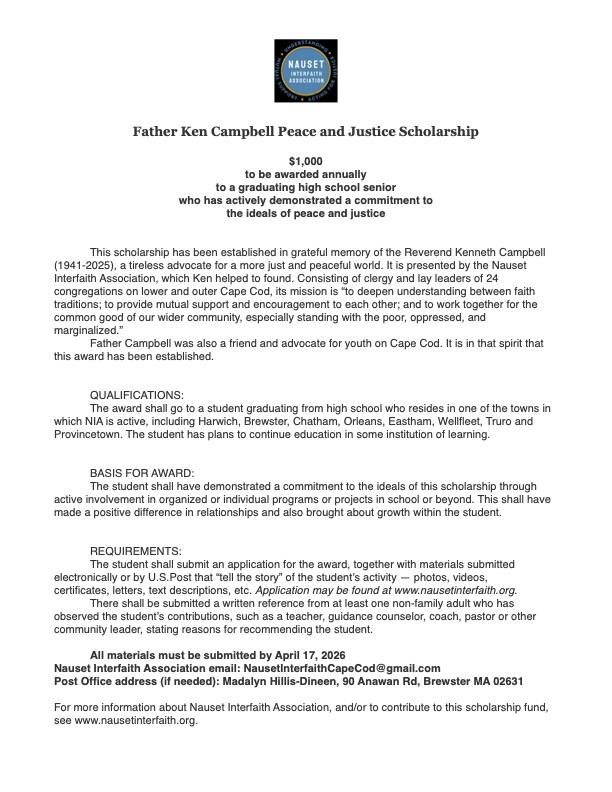
NIA announces student scholarship in honor of founding member Reverend Ken Campbell
The Father Ken Campbell Peace and Justice Scholarship has been established in grateful memory of the Reverend Kenneth Campbell (1941-2025), a tireless advocate for a more just and peaceful world. It is presented by the Nauset Interfaith Association, which Ken helped to found. Consisting of clergy and lay leaders of 24 congregations on lower and outer Cape Cod, its mission is “to deepen understanding between faith
traditions; to provide mutual support and encouragement to each other; and to work together for the
common good of our wider community, especially standing with the poor, oppressed, and
marginalized.” Father Campbell was also a friend and advocate for youth on Cape Cod. It is in that spirit that
this award has been established.
QUALIFICATIONS:
The award shall go to a student graduating from high school who resides in one of the towns in
which NIA is active, including Harwich, Brewster, Chatham, Orleans, Eastham, Wellfleet, Truro and
Provincetown. The student has plans to continue education in some institution of learning.
BASIS FOR AWARD:
The student shall have demonstrated a commitment to the ideals of this scholarship through
active involvement in organized or individual programs or projects in school or beyond. This shall have
made a positive difference in relationships and also brought about growth within the student.
REQUIREMENTS:
The student shall submit an application for the award, together with materials submitted
electronically or by U.S.Post that “tell the story” of the student’s activity — photos, videos,
certificates, letters, text descriptions, etc. Application may be found at www.nausetinterfaith.org.
There shall be submitted a written reference from at least one non-family adult who has
observed the student’s contributions, such as a teacher, guidance counselor, coach, pastor or other
community leader, stating reasons for recommending the student.
All materials must be submitted by April 17, 2026
Nauset Interfaith Association email: NausetInterfaithCapeCod@gmail.com
Post Office address (if needed): Madalyn Hillis-Dineen, 90 Anawan Rd, Brewster MA 02631
For more information about Nauset Interfaith Association, and/or to contribute to this scholarship fund,
see www.nausetinterfaith.org .
|
|
December, 2023
The Conversations With Police Task Force of the MLK Action Team will be the recipients of this year’s Rosenthal Award from the Barnstable County Human Rights Advisory Commission! (See the Cape Cod Times article here: https://nausetinterfaith.org/wp-content/uploads/2023/12/MLK-Police-Task-Force.pdf
The Rosenthal Community Champion Award, named after Irving Leopold Rosenthal, is given to individuals in the public sector (law enforcement, elected officials, etc.) recognized by their peers, community, and associates as individuals who have fostered and supported human rights, concepts, and ideals, particularly those who have worked to advance human rights and to eliminate discrimination against immigrants in Barnstable County.
The Human Rights Commission has told us that the work of the Task Force exemplifies these principles. They wrote “We honor the deep, hard work that all of you have put in to create real, impactful, lasting change in our communities.”
The Conversations with Police Task Force will be receiving this award at the annual Human Rights Celebration occurring on: Monday, December 11, 8:30 – 10:30 am at the Emeral Resort/ Hyport Conference Center, 35 Scudder Ave., Hyannis.
Visit this link for a more detailed description of the work of the Conversations With Police Task Force written by Action Team and Police Task Force member, Jeanne Morrison: https://nausetinterfaith.org/wp-content/uploads/2023/11/Work-of-Conversations-with-Police-pdf.pdf
July 2021
Chief Scott MacDonald of the Orleans PD recognizes the relationship built with the MLK Action Team Police Task Force as a contributor to Orleans receiving the first place Community Policing Award from the New England Association of Chiefs of Police. The task force has been meeting with the police chiefs from Chatham, Brewster, and Orleans for the last year with a focus on improving the relationship between the police and our communities of color.
Read the article from the Cape Cod Chronicle.